Here is the interview with Danny Meyer, restaurateur & CEO of Union Square Hospitality Group.
Saturday, 21 April 2012


Friday, 13 April 2012
Book: 大江大海(作者: 龍應台) Da Jiang Da Hai 1949 by Yingtai Long

Score: 4/5
(Cover picture from the web site of 博客來)
Embarrassingly, I have been quite ignorant of recent Chinese and Taiwanese history, especially pertaining to the 1900’s. Luckily, someone like Dr. Long had written this book to educate me on the subject.
This book is about the Chinese civil war in the year of 1949 between the Communist Party and the Nationalist Party, with the historical background on the Japanese invasion and WWII. Long wrote vividly and objectively on the past, telling stories of first hand accounts in the book from veterans and civilians. I am happy for this book placed more emphasis on the multifaceted perspective of the historical events, rather than focusing on one character and have the narrative revolve around one person.
Due to my lack of knowledge in Chinese history and geography, the book with its eyewitness accounts jumping from one person/location to another can at times be hard to follow. However, it did give a good sense of the zeitgeist of the era. It helped me to realize the horrors of war: teenagers were made to escape with their teachers from the war and separate from their parents, never to see them again. Some of them would climb onto such overcrowded trains that they had to sit on the rooftop, and a train tends to exit a tunnel with less people than when it went in. In one group, 5000 students who tried to escape the war had reached the Vietnam border with less than 300 students left. In prisoners of war camps, any small cut to the body meant certain and painful death, as infection ran rampant in the camp due to malnutrition and lack of medical care. Siblings saw their sisters raped dozens of times and hang themselves in desperation. Parents collapse in despair in a field of corpses upon finding their son/daughter’s mutilated body. In Leningrad, the city was encircled by the Germans for so long that cannibalism occurred and 500,000 civilians starved to death. It saddened me tremendously yet also made me cherish the peace I enjoy all the more.
As the book unfolds gradually with characters of vastly different backgrounds sharing their points of view and stories, a cultural identity and understanding slowly and vaguely emerged. I felt the book gave enough historical background to help me start understand the various sentiments between the different sides of the this civil war.
The civil war was fought in 1949, yet its consequences are ever more present today. This is an important book and I’d recommend it to anyone wanting to get a glimpse of living as a Chinese around the year 1949.
Sunday, 8 April 2012
Friday, 6 April 2012
Book: Steve Jobs by Walter Isaacson
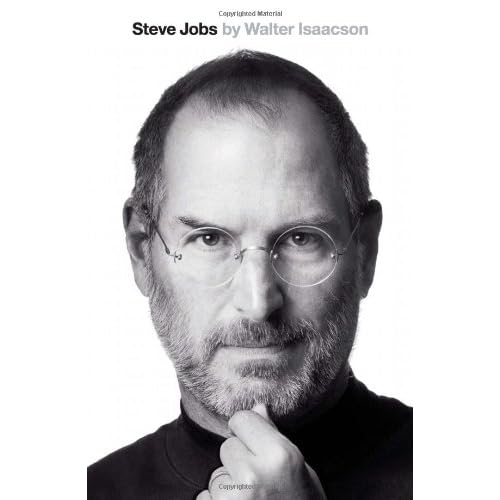
(Image from Amazon.ca)
Score: 4.5/5
I first got interested in Steve Jobs when playing with my friend’s iPod touch a few years ago. It was my first serious encounter with an Apple product. Though my initial reaction was “it’s just a fancified Walkman”, I was soon eager to try out all the function on the device and declared to my friend that I wanted one for myself.
I was intrigued and attracted to the device not only because it had a beautiful hardware and software interface, but also the entire user experience “flowed” graciously. The hassle of trying to figure out how to use the device is replaced with the joy of seeing yourself performing the functions without prior instructions, and the entire experience has consistency and elegance to it. It’s like being checked into a 5 star hotel by an fashionable, courteous, and experienced receptionist. So I wondered – what type of person does it take to create such a device and how did he do it?
Isaacson is a masterful writer who provided a balanced account of Jobs that is easy and delightful to read. At 571 pages it can feel long at times, but it’s a small price to pay for completeness. I highly recommend the book.
It would be naive to think this book is the definitive guide to being Steve Jobs, but there are many thought provokers in the book. This is what I derived from after reading the book:
- Much of Steve’s genius is in his ability as an editor. He may not know how to use a computer to draw out the specifications that engineers can understand, but he knew intuitively and logically what the customers wanted, how much they wanted them, who he can entrust to come up with solutions, and recognize a good solution when it is presented and present it to customers in an attractive and relatable way. Malcolm Gladwell says it very well here.
- Steve’s idea of design isn’t just aesthetic, it’s also philosophical. The goal of design is to create a beautiful and useful user experience, using both form and function to achieve that goal. I think he understands that though aesthetics can generate hype, tools that people find useful and easily accessible is what gives sustainable attachment. He often thought deeply and philosophically about what is the “essence” of the things he creates.
- One of Steve’s greatest contributions is design education – how technology can be “sexy”, and what beauty can mean in retail, movies, computer hardware, and software. Design has gotten more legitimacy and taken on more concrete form in the many industries, I think thanks to Steve. He also showed that art and technology can be a powerful combination, that the creative talents at Pixar are very disciplined, and that the software engineers at Apple can be really imaginative.
Ultimately, I wondered if Steve felt truly happy or fulfilled. He was certainly driven and cared deeply about his company, yet whether that gave him the satisfaction in return isn’t as clear to me. Steve is probably the only one with the answer.
I will let Steve end this post. Below is a quote of him about what motivates him to do his work:
What drove me? I think most creative people want to express appreciation for being able to take advantage of the work that’s been done by others before us. I didn’t invent the language or mathematics I use. I make little of my own food, none of my own clothes. Everything I do depends on other members of our species and the shoulders that we stand on. And a lot of us want to contribute something back to our species and to add something to the flow. It’s about trying to express something in the only way that most of us know how – because we can’t write Bob Dylan songs or Tom Stoppard plays. We try to use the talents we do have to express our deep feelings, to show our appreciation of all the contributions that came before us, and to add something to that flow. That’s what has driven me.
Wednesday, 4 April 2012
Video: “China Rediscovers its Own History” by Dr. Ying-Shih Yu
A fascinating talk from Dr. Yu, a renowned Chinese historian, at a Library of Congress event on the recent Chinese phenomenon to rediscover its roots. It covers many aspects of Chinese culture, commenting on the Taiwanese political situation regarding China, and on the Chinese legal system as well.
The video requires a RealPlayer plug in but that didn’t work for me. If you’re having the same issue, you can download it from my dropbox account here and watch it on RealPlayer.
Enjoy!
Tuesday, 3 April 2012
Video: 余英時----傑出華人系列part1 (with Chinese subtitle)
Dr. Yu is a renowned Chinese historian who taught at Harvard, Princeton,
and Yale. He won the John W. Kluge Prize for the Study of Humanity.
This is a short documentary film on him.
Sunday, 4 March 2012
Subscribe to:
Posts (Atom)